
The Complete Guide to Rooftop Solarfor Chennai Homes & Businesses
Everything to know about turning unused roof space into a long-term energy asset.
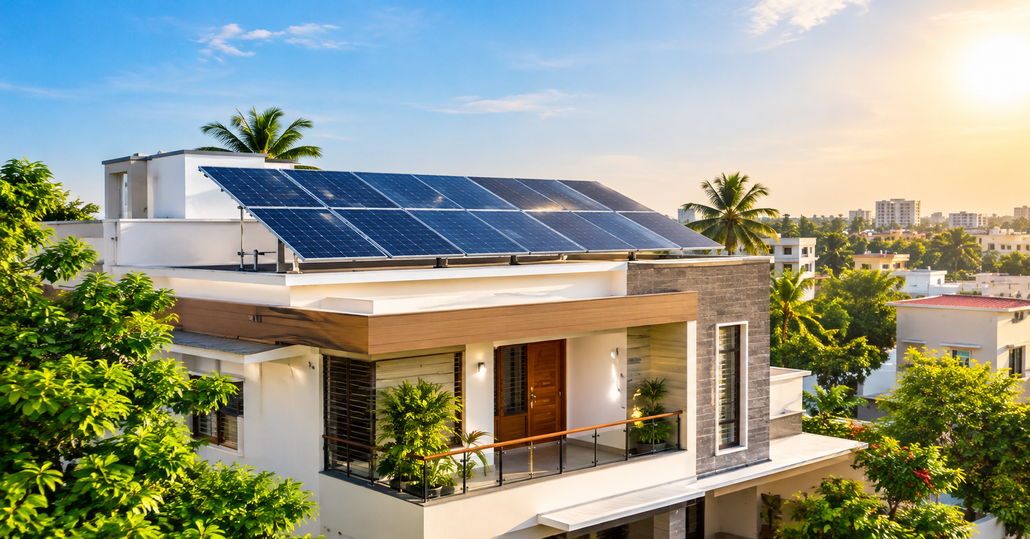
Rooftop solar in Chennai is the most common way homes and businesses go solar, and for good reason. First, it uses space you already have and requires no additional land. As a result, it can cut your electricity bill significantly within the first year. Here’s a practical look at how rooftop solar in Chennai works, what affects performance, and what to expect from start to finish.
1. Why Rooftop Solar Makes Sense
Most homes and small businesses already have a large, mostly unused asset sitting above them
— the roof. Rooftop solar converts that space directly into a source of electricity, without needing to
purchase or lease additional land. Combined with Chennai’s high annual sunlight hours, a
well-sized rooftop system can offset a large share of a household’s or business’s monthly power
consumption.
2. What Determines How Much Power Your Roof Can Generate
- Roof area and orientation — south-facing, unshaded roofs generate the most; even
east/west-facing roofs work well with correct panel tilt. - Shading — trees, water tanks, or neighboring buildings can meaningfully cut output, even
from just a few hours of shade a day. - Roof type and strength — RCC roofs are the easiest to mount on; sheet/metal roofs need
special mounting structures to ensure safety and longevity. - Your monthly consumption — system size should be based on your actual electricity usage,
not just available roof space.
3. The Installation Process, Step by Step
- Site survey — an engineer inspects your roof, checks shading and structure, and reviews
past electricity bills. - System design — panel count, inverter capacity, and layout are finalized based on your
consumption and roof space. - Installation — mounting structures, panels, wiring, and the inverter are installed, typically
within 3-5 days for a standard home. - Approvals — CEIG inspection, safety certification, and TANGEDCO net-metering registration
are completed to make the system fully compliant. - Commissioning — the system is switched on, the net meter is installed, and you start
generating your own power.
4. Maintenance: Less Than Most People Expect
Rooftop solar systems have very few moving parts, which keeps maintenance simple. Panels
typically need cleaning every few weeks to remove dust buildup (more frequently in high-dust
areas), and a basic annual check of wiring, connections, and inverter performance helps catch
issues early. Most quality panels carry 25-year performance warranties, so a well-installed system
is built to last for decades with minimal upkeep.
5. How Long Until It Pays for Itself?
Payback period depends on system size, roof conditions, and your electricity consumption. However, most residential rooftop systems in Tamil Nadu pay back their upfront cost within a few years through bill savings. After that, you get 20+ years of largely free electricity generation. In addition, net metering credits any surplus power you generate during the day against what you draw from the grid at night. As a result, your monthly bill keeps shrinking even when you use more power in the evening.
Find out what your roof could generate
Kandhan Solar carries out free site assessments for rooftop solar across Chennai —
covering system design, installation, and full CEIG, NCES, and TANGEDCO approval
support.
Call/WhatsApp: +91 90940 11042 | Web: kandhansolar.com
Door No. 4/20, Plot No. 274, 5th Street, Sunaresan Nagar, Karambakkam, Porur,
Chennai – 600116


Leave a Reply
Want to join the discussion?Feel free to contribute!