
Solar Subsidies in Tamil Nadu: A Complete 2026 Guide for Homeowners and Businesses

If you’ve been putting off going solar because you’re not sure what subsidies you actually qualify for, now is a good time to look again. Between the central government’s PM Surya Ghar scheme and Tamil Nadu’s own new state-level top-up, the combined support available to a typical household has never been higher— and TANGEDCO has streamlined much of the paperwork that used to make the process feel intimidating. Here’s a clear, no-jargon breakdown of what’s on offer, who qualifies, and how the application actually works.
The Two Layers of Subsidy
1. The Central Scheme — PM Surya Ghar Muft Bijli Yojana
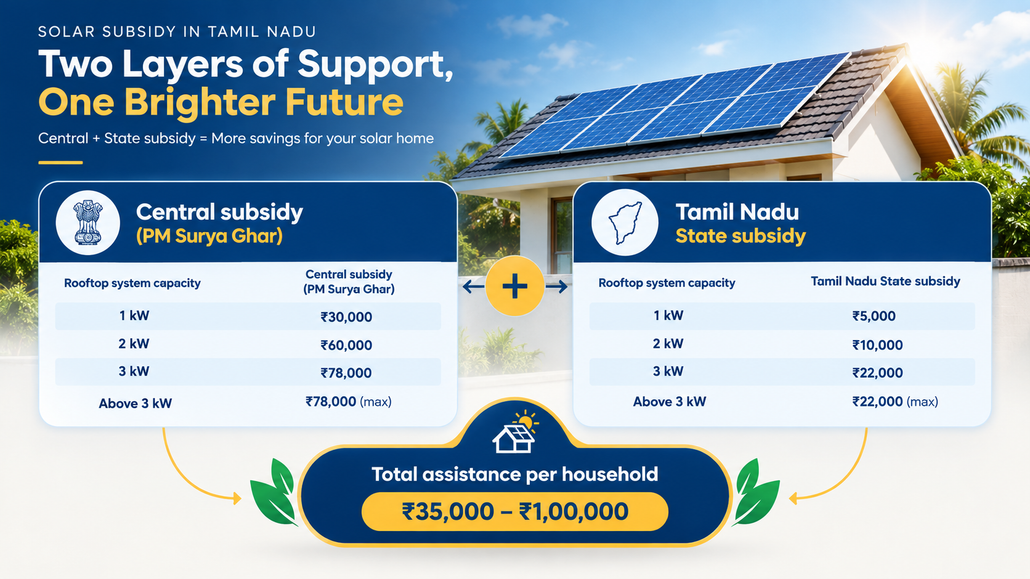
This is the national rooftop solar program, and it provides the foundation for applications in Tamil Nadu. It offers:
- ₹30,000 per kW for the first 2 kW of system capacity
- ₹18,000 for the 3rd kW
- A cap of roughly ₹78,000 for systems of 3 kW and above
The program has no income ceiling. Your income does not affect eligibility. You must own a residential property with an active TANGEDCO connection. An MNRE-empanelled vendor must carry out the installation. Furthermore, the property must not have previously received a central subsidy for rooftop solar. As a result, previous beneficiaries may not be eligible to apply again.
2. The New State Top-Up (Tamil Nadu Budget 2026–27)
In its 2026–27 budget, the Tamil Nadu government announced a new Rooftop Solar Subsidy Scheme designed to work alongside the central program rather thanreplace it. Combined, the two schemes can now bring total support up to about ₹1 lakh per home — a significant jump from what was available even a year ago, and a strong signal that the state wants to accelerate rooftop adoption well beyond the roughly one lakh households currently covered.
Who’s Eligible
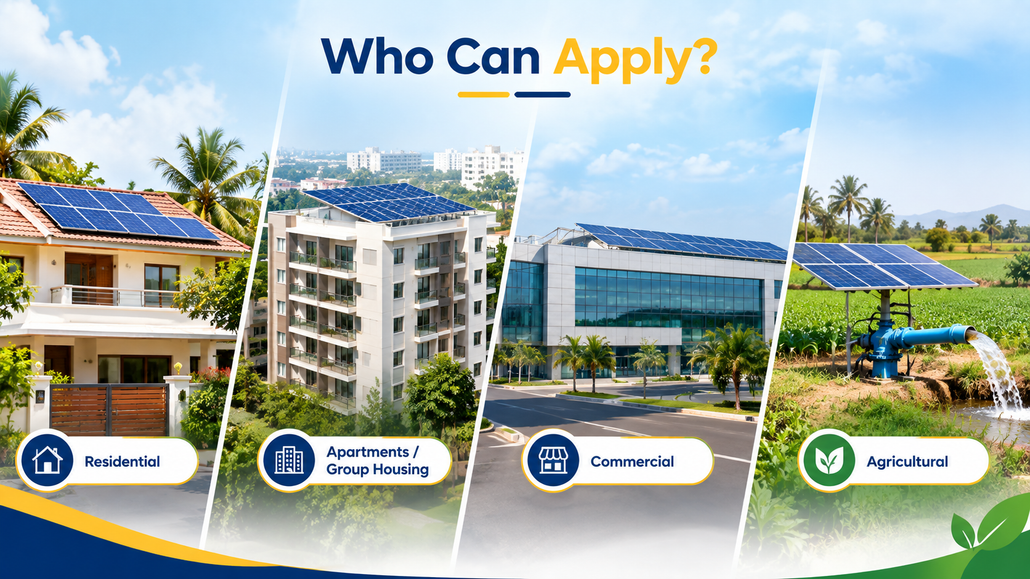
The schemes aren’t limited to single-family homes. Coverage generally extends to:
1.Residential consumers (including apartments and group housing)
2.Commercial establishments — shops, offices, small hospitals
3.Educational institutions
4.Agricultural consumers, including pump-set connections
5.Industrial units under the LT (low-tension) category
Systems above 10 kW go through an additional feasibility study and a transformer capacity check before approval, which is standard practice to make sure the local grid infrastructure can handle the added capacity.
How the Application Process Works
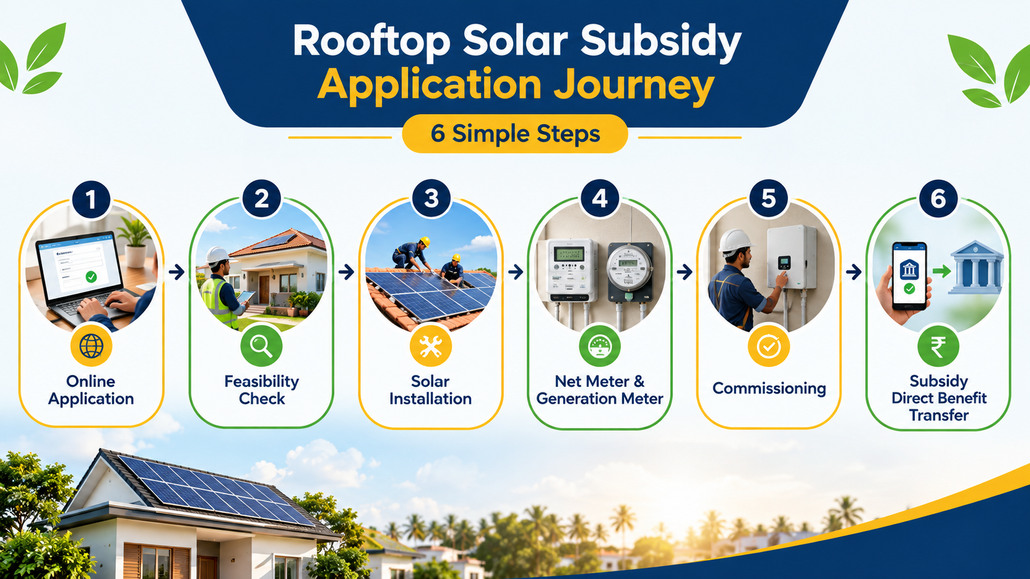
TANGEDCO acts as the nodal agency for the whole process in Tamil Nadu, and almost everything now runs through its Unified Solar Rooftop Portal. In broad
strokes:
- Apply online through the portal with your consumer details and proposed system capacity.
- Feasibility check — TANGEDCO assesses technical suitability, which typically takes 7–15 working days in urban areas.
- Installation by your chosen registered vendor, usually completed within 1–2 days for a standard 3 kW residential system.
- Net meter and generation meter installation — You can apply for both through TANGEDCO after installation. Your installer should coordinate the process for you.
- Commissioning certificate — Your installer uploads the certificate to the portal along with your bank details.
- Subsidy disbursement via Direct Benefit Transfer, generally within 30–60 days of commissioning.
A practical tip: don’t commission the system before TANGEDCO’s feasibility approval comes through — jumping ahead can complicate the subsidy claim later.
Net Metering: Where the Real Long-Term Savings Come From
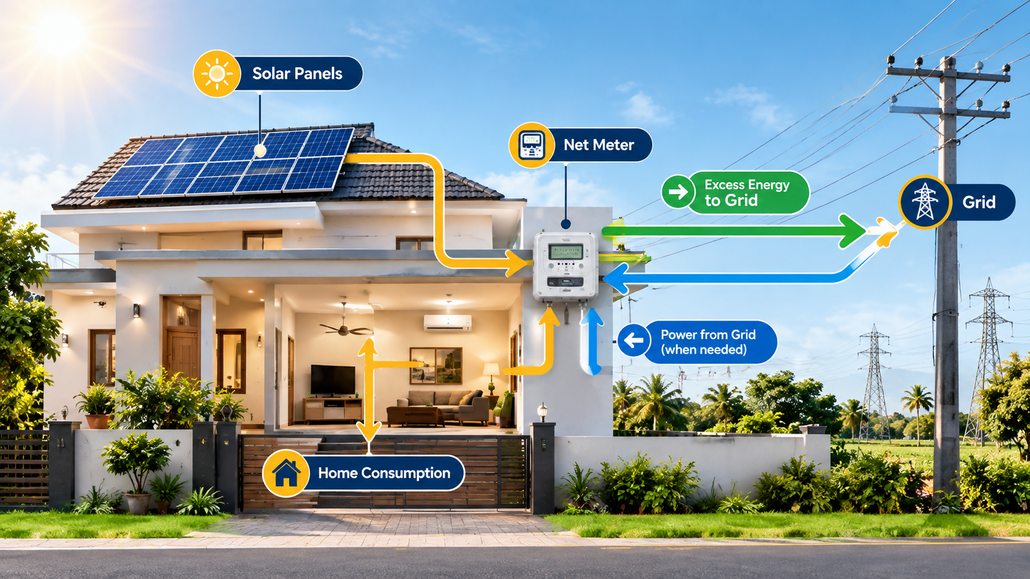
Beyond the upfront subsidy, net metering is what makes solar genuinely pay for itself over time. Under the TNERC (Tamil Nadu Electricity RegulatoryCommission) framework that TANGEDCO implements, any solar power you generate but don’t use is exported to the grid, and you’re billed only for your net consumption — what you draw from the grid minus what you send back. For most households, this is what pushes electricity bill reductions into the 40–90% range
depending on system size and usage patterns.
One thing worth checking, especially if you’re on subsidised or free electricity units, is how net metering interacts with your existing consumption-based subsidies. For example, the rules may differ from those that apply to a standard metered household, and therefore it’s important to confirm the details with TANGEDCO or your installer before applying.Therefore, before applying, it’s worth confirming the details with TANGEDCO or your installer. This way, you can understand how the subsidy and net-metering arrangements will work together and avoid any unexpected changes to your electricity bill.
Why the Timing Matters

The central scheme operates on a fixed national budget, and it’s designed to run only until either the funding is exhausted or the installation target is reached —whichever comes first. It isn’t an open-ended entitlement. With the new state top-up now stacking on top of it, Tamil Nadu households currently have access to more combined support than at almost any point since these programs launched, but that window is tied to budget availability rather than a fixed end date.
How Kandhan Solar Can Help
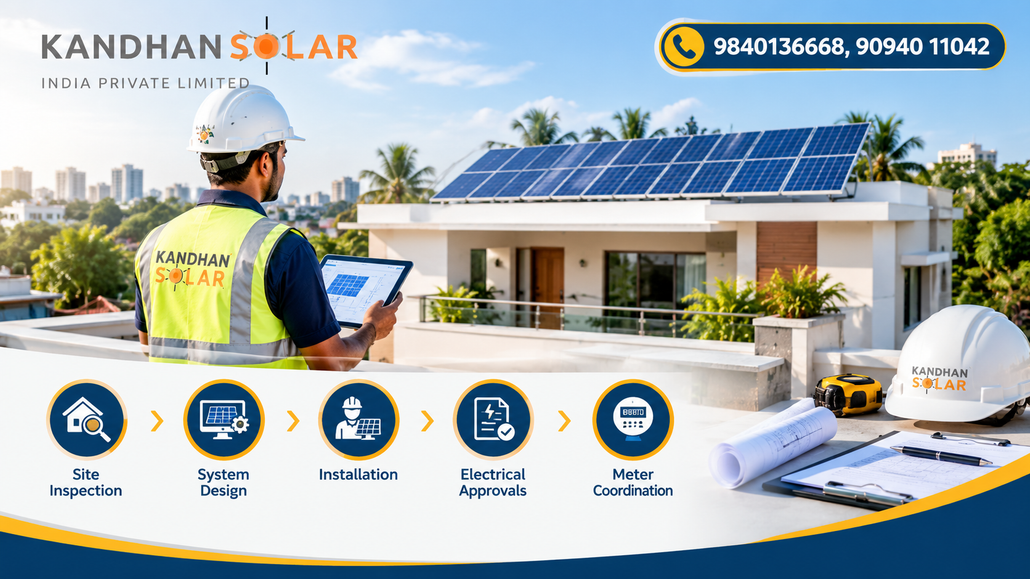
Navigating feasibility approvals, vendor registration, and meter paperwork can be time-consuming. Kandhan Solar can handle the full process for you.
We manage each step from the initial site assessment to system design. We also coordinate CEIG, NCES, and TANGEDCO approvals. Our support continues through generation meter compliance and performance monitoring.
Are you a homeowner looking to reduce your electricity bill? We can help you understand the available subsidy options.
Are you a business considering a CAPEX or OPEX solar project? We can guide you through the process and manage the required paperwork.
Are you a farmer considering a pump-set connection? Our team can explain the applicable subsidy and help with the documentation.
Ready to see what you could save? Get in touch with our team for a free site assessment.
We will provide a personalised quote based on your roof area and energy consumption.

This article reflects publicly available subsidy information from the Tamil Nadu 2026–27 budget announcement.
MNRE and the Tamil Nadu government set the subsidy amounts, eligibility criteria, and disbursement timelines. These details may change over time.
Always confirm the latest figures with TANGEDCO or your solar installer before applying.


Leave a Reply
Want to join the discussion?Feel free to contribute!